U.S. Army Truck Company 28. Punitive Expedition.
Light trucks in use by the U.S. Army, World War One.
That convoy proved to be an epic ordeal, which served as much as anything to demonstrate that American roads were really all local, and in some cases nearly impassable, affairs. But the fact that the trucks did make it proved a point, and it wasn't all that long thereafter when a true interstate highway system was put into the works. Indeed, the it already was as Congress had first entered the picture legislatively in 1916, with the Federal Road Aid Act of 1916. In 1921 Congress passed a new act, the Federal Aid Highway Act of 1921 which provided matching funds for highway construction and acted to have the Army target highways that were vital to national defense. Therefore, contrary to the general supposition that this first occurred under the Eisenhower Administration, in fact the Army became involved in highway construction, in a fashion, in 1921. In 1922 the Army had identified 20,000 miles of road that it considered vital.
Road construction boomed in the 1920s, and by the 1930s thousands of miles of paved, or concrete, roads had been put in and the road age had really arrived. Many of the old dirt public roads, which could really only serve local purposes, and which took hours of travel in order to go even modest distances, were replaced with paved roads that greatly increased the speed of travel. Small stores and gas stations, in turn, popped up everywhere, as vehicles of the era really only held a modest amount of gasoline. With the increase in roads everywhere, an increase in truck traffic came in as well.

Fairly typical commercial trucks, 1940.
At first, and for a very long time, most truck traffic really remained only local. However, even by the 1930s tractor trailers had become relatively common, having made their appearance some time before. So the beginning of longer hauls were there. These trucks were somewhat modest in size compared to the ones we see now, but they were there and they were used, although more often for intrastate hauls or relatively short hauls, by modern standards.
Tractor trailer combinations, 1930.

Trucks delivering tucks, 1931.
At the same time, the pickup truck very much made its appearance. At first most pickups were converted cars, with conversions of Model Ts being quite common. But as the type proved so utilitarian soon major automobile manufacturers began to offer them, and they became a staple for small businesses, farms and ranches. All were two wheel drive at this point.
Very early example of a truck that would come to be thought of as the pickup truck.
Pickup truck in farm use, 1930s.
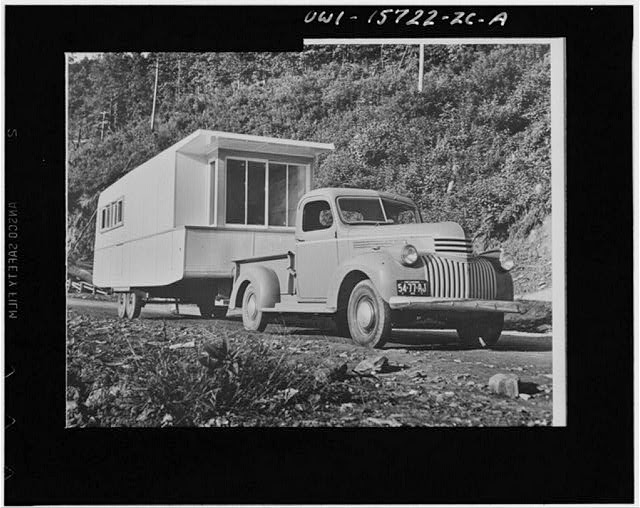
Truck and trailer, late 1930s.
None of which is to say or suggest that trucks supplanted horse and mule drawn wagons by this point. They were starting too, quite clearly, but horse and mules remained very much in evidence the entire time.
Also contrary to widely held belief, the post Great War period, followed by the Twenties and the Great Depression did not see the Army supplant horses entirely by any means, but it did see the artillery branch, specifically the field artillery, take a huge interest in trucks.
Various nations artillery branches has started to use trucks as "artillery tractors" during World War One, with every major army using some. The heavier the piece, the more likely that an army was using an artillery tractor to tow it. Following World War One, the U.S. Army in particular had an enormous interest in trucks. Indeed, the artillery was arguably more interested in trucks than any other branch of the Army.
What the artillery branch found was that there really weren't any artillery tractors of the type that it wanted, and that it new could be built. Available trucks, for the most part, were two axle, two wheel drive, low geared trucks. All wheel drive trucks did start coming in during this period, but they were very heavy indeed, and mostly used for very rugged rural enterprises, such as logging. The artillery wanted a truck that was all wheel drive, but still capable of effective road use. As there wasn't such a vehicle, it set out inventing one.
And it was successful, which oddly put the Federal government, for awhile, in the truck manufacturing business. While these 6x6 artillery tractors proved to be immediately successful, they also proved to be very expensive, and in a nation with such a massive automobile industry, it soon came to be the case that nobody could see a really good reason why the Federal government should be operating a truck company, so this line of truck, during the 1930s, was contracted out as a type to various civilian manufacturers.
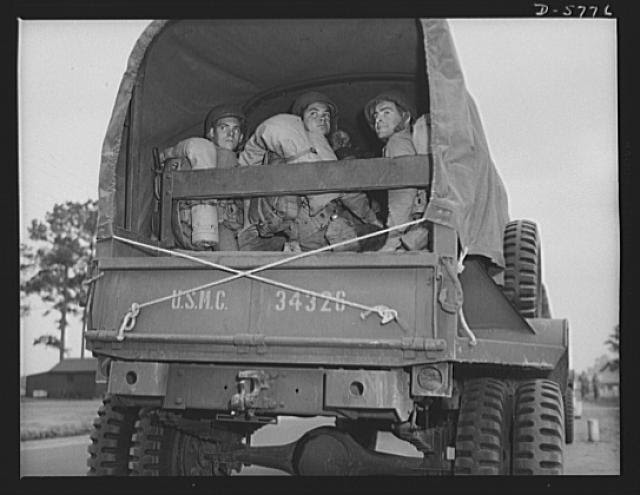
Marines riding in heavy 4x4 truck early in World War Two. This type would soon be supplanted by 6x6 trucks.
Right about the same time, the Army, having seen the utility of 6x6 trucks, began to desire 4x4 trucks as well, and these were also contracted for. Just prior to the United States entering World War Two the Army had adopted and was purchasing, therefore, a wide range of all wheel drive trucks, ranging from the newly adopted and very small 1/4 ton truck, the Jeep, to 4x4s and 6x6s. Other armies were likewise experimenting with fall wheel drive vehicles but no other nation did to the same extent as the U.S, which by the wars end was at any rate supplying at least some trucks to every Allied army.
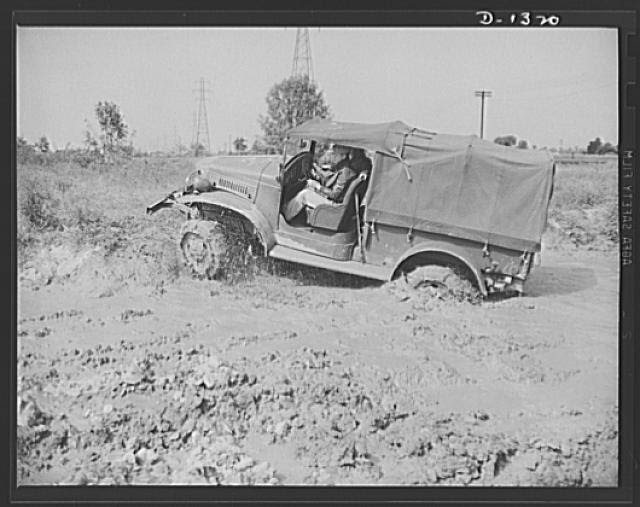
World War Two era Dodge 4x4 truck. With very little in the way of change, this model would go into civilian production immediately after World War Two.
Four wheel drive trucks brought about a
revolution in transportation in rural quarters that has already been addressed by this blog, so we won't go back into it, other than that to say after World War Two every major U.S. automobile manufacturer, and there were more major ones at that time, had experience in building 4x4s. And as they were offered to civilians, they slowly came to be a major automobile type were today, they are very common. In my region of the country it's so rare as to see a 2x4 pickup truck that its actually a bit surprising now when a newer one is encountered. They aren't something you see much, and most automobile lots have only 4x4s for sale here, as a rule. This hasn't always been the case, but it certainly is the case now.
Following the Second World War the U.S. saw a rising expansion of over the road trucking. By the late 1950s the US was, additionally, overhauling its Interstate highway system via the Defense Department's budget with new "defense" highways, which were much improved compared to the old Interstate highway system. With the greatly improved roads, by the 1960s, interstate long haul trucking was in an advance state of supplanting the railroads for a lot of American freighting. At the same time, the diesel engine supplanted the gasoline engine for semi tractors. A very uncommon engine for motor vehicles in the United States prior to the 1950s, diesels started coming in somewhere in that period and by the 1960s they'd completely replaced gasoline engines for over the road semi tractors. Now, of course, diesels have become fairly common for heavy pickups as well, and are even starting to appear in the U.S. in light pickup trucks in spite of the higher cost of diesel fuel.
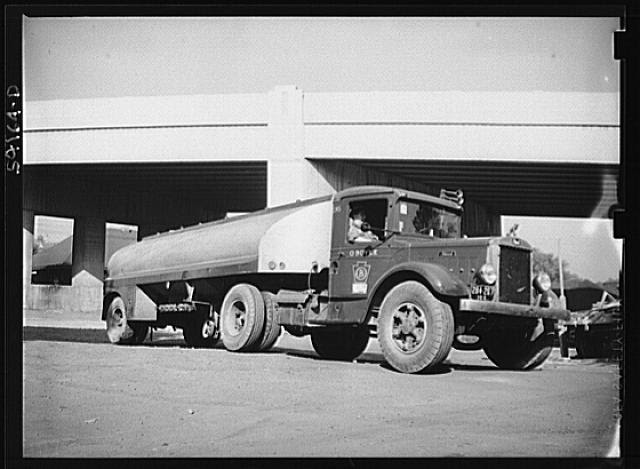
Mack tractor, 1942.
The change was dramatic, although few people can probably fully appreciate that now, as we are so acclimated to trucking. Thousands of trucks supplanted thousands of rail cars, and entire industries that were once served only by rail came to be served by truck. The shipping of livestock, for example, which was nearly exclusively a railroad enterprise up into the 1950s is now done entirely by truck, a change which had remarkable impacts as rail shipping required driving the livestock to the railhead, whereas with the trucks they are simply scheduled to arrive at a ranch at a particular time. Likewise, businesses that at one time located themselves near rail lines, so that they could receive their heavy products by rail, no longer do, as they receive those items by trucks. For example, pipeyards, once always near a railhead, are not always today.
Not that the railroads have disappeared. Indeed, in recent years they've once again been expanding, as they're very cost efficient and even more "green" than trucking, as they point out. But trucks have, in the past 60 years, gone from something that was really for short hauls, for the most part, to something that is now common for long hauls, and indeed the bulk of American shipping is now done by truck. Trucks have an advantage in being able to go more selectively and directly from "port to port", and the surface on which they travel is of course, put in by the public, making it a partially subsidized industry. So they aren't going away soon, in spite of a revitalized rail industry.
And trucks have became part of the American vehicular fleet in a way that would have been hardly imaginable even 50 years ago. As they've become more comfortable to drive, and easier to drive, they've been a common family vehicle, which is not what they once were. Pickup trucks used to be pretty much only owned by people who had some need of them, even if that need was recreational. Now, they're common everywhere. Indeed, the Ford F150, Ford's 1/2 ton pickup truck, has been the best selling vehicle, that's vehicle, not truck, for the past 32 years. So, so common have trucks become in the United States that one model of 1/2 tone truck is the number one single high selling model of vehicle. Pretty amazing for a vehicle that started off as utilitarian and industrial.


 Fairly typical commercial trucks, 1940.