Monday, May 15, 2023

Lex Anteinternet: Toyota Landcruiser: The Prime Mover of the Third World Military.

Lex Anteinternet: Toyota Landcruiser: The Prime Mover of the Third ...:      

Toyota Landcruiser: The Prime Mover of the Third World Military.


 Moroccan troops with some sort of Toyota, United States Marine Corps photograph.

Americans may have invented the  Jeep, but based on what you see in the news, the Japanese surely perfected the type.  The Toyota Land Cruiser of the FJ type is surely the prime mover of the third world and irregular military.   This past week, I saw news footage of a fairly  new pattern of Toyota Landcruiser (or whatever they're calling them now) that had been fitted out with a rocket launcher, being used in Iraq, by the Iraqi army.

Whatever that pattern is, they don't import it here.  Universal (i.e., light small 4x4 trucks of the Jeep type) have gone from being a product offered solely by Willy, to being one, as I've noted before, that was offered by many manufacturers, to include Toyota, Rover, Nissan, and Ford, amongst others.  Now the numbers have dwindled back down so that the only common one is the Jeep once again, now a Chrysler product, unless you include Toyota's somewhat larger option.  Mercedes does make a Jeep type vehicle that's imported into the US, but you rarely see one.  And I know at least Steyr makes one overseas.  Jaguar, the current owner of the Rover brand, might as well.

No matter, it's Toyota that has the light military vehicle role all sewn up all over the glove.  Every third world army everywhere, and every mobilized irregular guerrilla outfit, uses them too.  They must be a fantastic light truck.  While I know it'd be very politically incorrect, were I in the Toyota advertising department, I'd propose the slogan "Toyota Landcruiser:  The prime mover of the third world army".

Sunday, May 14, 2023

Lex Anteinternet: Automotive Transportation I: Trucks and Lorries

Lex Anteinternet: Automotive Transportation I: Trucks and Lorries

Automotive Transportation I: Trucks and Lorries

Truck Train, May 1920.

We have, in this continuing series on transportation, looked at trainsplanesships, and shoe leather.  We're going to start looking at the type of transportation now that's just part of the regular background of our lives, for most of us.  Automobiles.

In doing this, I've broken the topic up into two, and perhaps oddly, I've started with trucks and lorries.  That probably seems backwards, but for what we're doing it really isn't. Transportation by truck has been a major change in the basic distribution system for the nation.

First of all, we probably better get some basic definitions down.  I've used, in the caption to this entry, terms that are somewhat unique to differently localities.  A "truck" is to Americans and Canadians what a "lorry" is to the English.  I don't know why, but they are.  And that's sort of illustrative of what we're trying to address here, which is the commercial vehicle.  A unique hauling vehicle designed to move objects and operated by people, rather than an automobile designed to haul principally people.  We'll get to cars, or sedans, later.

Trucks are as old as the internal combustion engine, which itself dates to basically the second half of the 19th Century. The history of the internal combustion engine is surprisingly convoluted and long, and there are different early engines that could compete for the claim of being the very first such engine. Suffice it to say, for our purposes, the introduction of the internal combustion engine had its way paved by a different type of engine, really, that being the steam engine. And in fact, the steam engine, along with electric motors, competed with early internal combustion engines for the role of individual vehicle power plant for quite some time.  As early as the 1870s, at any rate, such familiar names as Benz and Daimler were introducing internal combustion engines that would be recognizable as ancestors to the current ones.  Rudolph Diesel had designed the early variants of the engine that bears his name by 1893.  Even such theoretically advanced engine features such as the supercharger were 19th Century inventions.

So the early engines were around in the late 19th Century, but what it took to really get the vehicles up and rolling, so to speak as viable alternatives to horse and locomotive was cheap fuel, which oddly enough is rapidly reaching the pinnacle of its cheapness in our very own era.  And that took petroleum exploration.  As this isn't a history of petroleum exploration, we'll forgo looking into that in this thread.  Perhaps we'll look at it at some time in the future.  What it also took, however, was an affordable set of vehicles.

Trucks came in, therefore, quite early, but as practical machines they really began to make their appearance felt just prior to World War One.  By that time, there were some really stout industrial trucks chugging around, and that's basically what they were doing, around American cities.  They were the competitor to draft horses pulling wagons and carts.


They did not all operate exactly the same way that modern trucks do. Some did, with engine and transmission, but others were chain driven, like motorcycles were (and some still are).  But as heavy as they were, they tended to be pretty prone to maintenance problems and they were, in some ways, more comparable to industrial machines than to the modern trucks we have today.

They also didn't stray much into the sticks. They didn't have the range for it, and they were too expensive for many rural users.  Nonetheless, they began to come into military use just prior to World War One.  The U.S. First Aero Squadron was the first fully motorized unit of the U.S. Army and saw deployment in the Punitive Expedition, where its trucks proved as great of value, if not greater, than its aircraft.

U.S. Army Truck Company 28.  Punitive Expedition.

Trucks went on to see widespread use by every army during the Great War and while they did not displace the horse in any role, they were basically proven by the end of the war.  This was so much the case that the United States Army, as part of a grand experiment, ordered a convoy of various types of trucks and vehicles then its possession to cross the United States in 1919, just one year after the conclusion of the war.

 British brewery truck, an early example of a truck directly replacing a role generally filled by horses, in use here to haul cannon parts.

 Light trucks in use by the U.S. Army, World War One.

That convoy proved to be an epic ordeal, which served as much as anything to demonstrate that American roads were really all local, and in some cases nearly impassable, affairs.  But the fact that the trucks did make it proved a point, and it wasn't all that long thereafter when a true interstate  highway system was put into the works.  Indeed, the it already was as Congress had first entered the picture legislatively in 1916, with the Federal Road Aid Act of 1916.  In 1921 Congress passed a new act, the Federal Aid Highway Act of 1921 which provided matching funds for highway construction and acted to have the Army target highways that were vital to national defense.  Therefore, contrary to the general supposition that this first occurred under the Eisenhower Administration, in fact the Army became involved in highway construction, in a fashion, in 1921.  In 1922 the Army had identified 20,000 miles of road that it considered vital.

Road construction boomed in the 1920s, and by the 1930s thousands of miles of paved, or concrete, roads had been put in and the road age had really arrived.  Many of the old dirt public roads, which could really only serve local purposes, and which took hours of travel in order to go even modest distances, were replaced with paved roads that greatly increased the speed of travel.  Small stores and gas stations, in turn, popped up everywhere, as vehicles of the era really only  held a modest amount of gasoline.  With the increase in roads everywhere, an increase in truck traffic came in as well.
 

Trucks outside of a starch factory, Caribou, Aroostook County, Me. There were almost fifty trucks in the line. Some had been waiting for twenty-four hours for the potatoes to be graded and weighedFairly typical commercial trucks, 1940.

At first, and for a very long time, most truck traffic really remained only local.  However, even by the 1930s tractor trailers had become relatively common, having made their appearance some time before. So the beginning of longer hauls were there.  These trucks were somewhat modest in size compared to the ones we see now, but they were there and they were used, although more often for intrastate hauls or relatively short hauls, by modern standards.


 93.  Neg. No. F-78K, Aug 11, 1930, EXTERIOR-ASSEMBLY BUILDING, NORTH SIDE, WITH TAYLOR-TRUCK-A-WAY TRUCKS AND TRAILORS - Ford Motor Company Long Beach Assembly Plant, Assembly Building, 700 Henry Ford Avenue, Long Beach, Los Angeles County, CA
Tractor trailer combinations, 1930.


94.  Neg. No. F-130, Sep 24, 1931, EXTERIOR-OFFICE BUILDING AND ASSEMBLY BUILDING, WEST SIDE, SHOWING TRUCKS AND TRAILORS LOADED WITH NEW TRUCKS DISPLAYING SIGNS 'MORE FORDS FOR HOOVER DAM' - Ford Motor Company Long Beach Assembly Plant, Assembly Building, 700 Henry Ford Avenue, Long Beach, Los Angeles County, CA
 Trucks delivering tucks, 1931.

At the same time, the pickup truck very much made its appearance.  At first most pickups were converted cars, with conversions of Model Ts being quite common. But as the type proved so utilitarian soon major automobile manufacturers began to offer them, and they became a staple for small businesses, farms and ranches.  All were two wheel drive at this point.

 Very early example of a truck that would come to be thought of as the pickup truck.

 Pickup truck in farm use, 1930s.


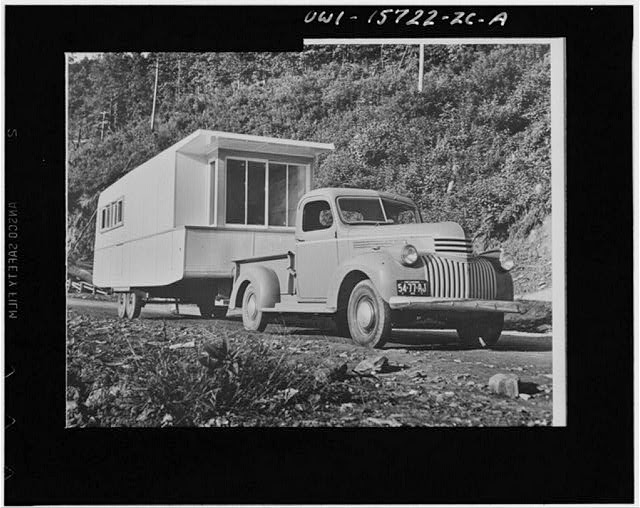
Truck and trailer, late 1930s.

None of which is to say or suggest that trucks supplanted horse and mule drawn wagons by this point. They were starting too, quite clearly, but horse and mules remained very much in evidence the entire time.

Also contrary to widely held belief, the post Great War period, followed by the Twenties and the Great Depression did not see the  Army supplant horses entirely by any means, but it did see the artillery branch, specifically the field artillery, take a huge interest in trucks.

Various nations artillery branches has started to use trucks as "artillery tractors" during World War One, with every major army using some. The heavier the piece, the more likely that an army was using an artillery tractor to tow it.  Following World War One, the U.S. Army in particular had an enormous interest in trucks.  Indeed, the artillery was arguably more interested in trucks than any other branch of the Army.

What the artillery branch found was that there really weren't any artillery tractors of the type that it wanted, and that it new could be built.  Available trucks, for the most part, were two axle, two wheel drive, low geared trucks.  All wheel drive trucks did start coming in during this period, but they were very heavy indeed, and mostly used for very rugged rural enterprises, such as logging. The artillery wanted a truck that was all wheel drive, but still capable of effective road use. As there wasn't such a vehicle, it set out inventing one.

And it was successful, which oddly put the Federal government, for awhile, in the truck manufacturing business.  While these 6x6 artillery tractors proved to be immediately successful, they also proved to be very expensive, and in a nation with such a massive automobile industry, it soon came to be the case that nobody could see a really good reason why the Federal government should be operating a truck company, so this line of truck, during the 1930s, was contracted out as a type to various civilian manufacturers.

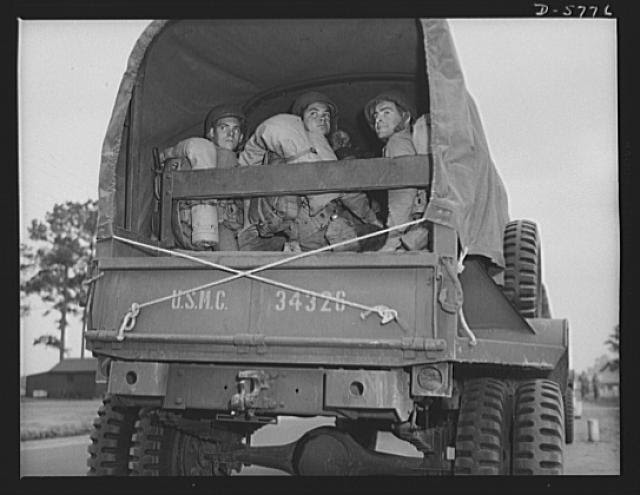
 New River, North Carolina. Marine truck transport units. Trucks that will carry leathernecks in combat areas are used in war exercises at New River, North Carolina. This truck, rolling along in a Marine convoy, serves many useful war purposes. Marine barracks, New River, North Carolina
Marines riding in heavy 4x4 truck early in World War Two. This type would soon be supplanted by 6x6 trucks.

Right about the same time, the Army, having seen the utility of 6x6 trucks, began to desire 4x4 trucks as well, and these were also contracted for.   Just prior to the United States entering World War Two the Army had adopted and was purchasing, therefore, a wide range of all wheel drive trucks, ranging from the newly adopted and very small 1/4 ton truck, the Jeep, to 4x4s and 6x6s.  Other armies were likewise experimenting with fall wheel drive vehicles but no other nation did to the same extent as the U.S, which by the wars end was at any rate supplying at least some trucks to every Allied army.

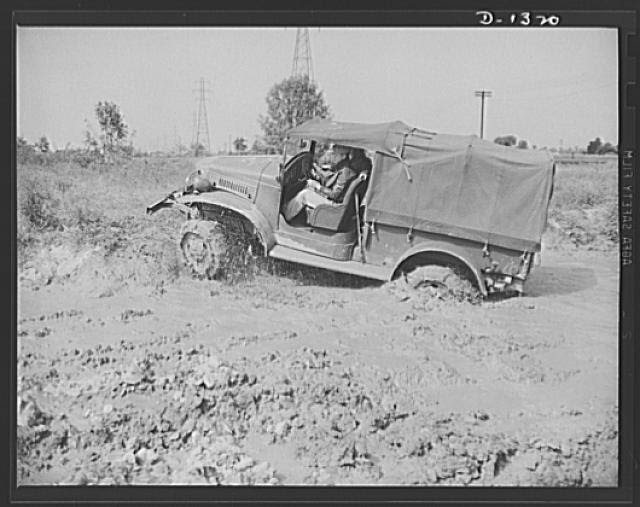
 Army truck manufacture (Dodge). Army officers attending the school conducted by the Chrysler Corporation to assist our fighting forces in the job training men to operate the thousands of trucks required by today's streamlined division are given actual practice in driving the trucks in a testing field. Above is an Army officer putting one of these trucks through its paces in a heavy mud wallow which is just one of the many tests to which the driver and vehicle are subjected
World War Two era Dodge 4x4 truck.  With very little in the way of change, this model would go into civilian production immediately after World War Two.

Four wheel drive trucks brought about a revolution in transportation in rural quarters that has already been addressed by this blog, so we won't go back into it, other than that to say after World War Two every major U.S. automobile manufacturer, and there were more major ones at that time, had experience in building 4x4s.  And as they were offered to civilians, they slowly came to be a major automobile type were today, they are very common.  In my region of the country it's so rare as to see a 2x4 pickup truck that its actually a bit surprising now when a newer one is encountered.  They aren't something you see much, and most automobile lots have only 4x4s for sale here, as a rule.  This hasn't always been the case, but it certainly is the case now.

Following the Second World War the U.S. saw a rising expansion of over the road trucking.  By the late 1950s the US was, additionally, overhauling its Interstate highway system via the Defense Department's budget with new "defense" highways, which were much improved compared to the old Interstate highway system.  With the greatly improved roads, by the 1960s, interstate long haul trucking was in an advance state of supplanting the railroads for a lot of American freighting.  At the same time, the diesel engine supplanted the gasoline engine for semi tractors.  A very uncommon engine for motor vehicles in the United States prior to the 1950s, diesels started coming in somewhere in that period and by the 1960s they'd completely replaced gasoline engines for over the road semi tractors.  Now, of course, diesels have become fairly common for heavy pickups as well, and are even starting to appear in the U.S. in light pickup trucks in spite of the higher cost of diesel fuel.

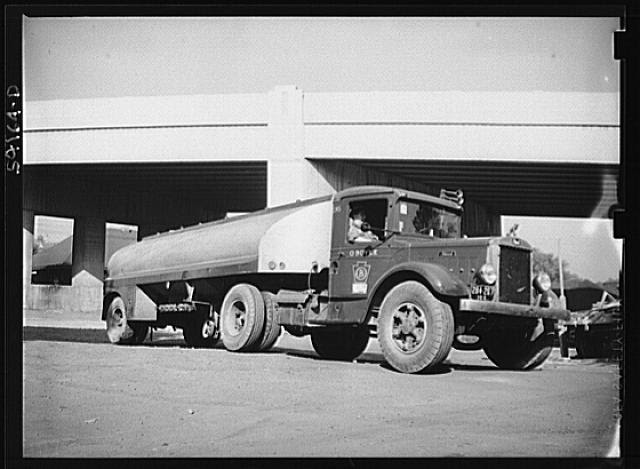
 Washington, D.C. An O. Boyle tank truck on the door of which is displayed a United States Truck Conservation Corps pledge
 Mack tractor, 1942.

The change was dramatic, although few people can probably fully appreciate that now, as we are so acclimated to trucking.  Thousands of trucks supplanted thousands of rail cars, and entire industries that were once served only by rail came to be served by truck.  The shipping of livestock, for example, which was nearly exclusively a railroad enterprise up into the 1950s is now done entirely by truck, a change which had remarkable impacts as rail shipping required driving the livestock to the railhead, whereas with the trucks they are simply scheduled to arrive at a ranch at a particular time.  Likewise, businesses that at one time located themselves near rail lines, so that they could receive their heavy products by rail, no longer do, as they receive those items by trucks.  For example, pipeyards, once always near a railhead, are not always today.

Not that the railroads have disappeared.  Indeed, in recent years they've once again been expanding, as they're very cost efficient and even more "green" than trucking, as they point out.  But trucks have, in the past 60 years, gone from something that was really for short hauls, for the most part, to something that is now common for long hauls, and indeed the bulk of American shipping is now done by truck.  Trucks have an advantage in being able to go more selectively and directly from "port to port", and the surface on which they travel is of course, put in by the public, making it a partially subsidized industry.  So they aren't going away soon, in spite of a revitalized rail industry.

And trucks have became part of the American vehicular fleet in a way that would have been hardly imaginable even 50 years ago.  As they've become more comfortable to drive, and easier to drive, they've been a common family vehicle, which is not what they once were.  Pickup trucks used to be pretty much only owned by people who had some need of them, even if that need was recreational.  Now, they're common everywhere.  Indeed, the Ford F150, Ford's 1/2 ton pickup truck, has been the best selling vehicle, that's vehicle, not truck, for the past 32 years.  So, so common have trucks become in the United States that one model of 1/2 tone truck is the number one single high selling model of vehicle.  Pretty amazing for a vehicle that started off as utilitarian and industrial.

Lex Anteinternet: Friday, May 14, 1943. Victory Speed.

Lex Anteinternet: Friday, May 14, 1943. The sinking of the AHS Cent...

Friday, May 14, 1943.  


The United States Public Roads Administration reported that only a few states were observing the 35 mph wartime highway "Victory Speed Limit" imposed by the Federal Government.

35mph is slow, but not quite as slow as it would now be regarded.  Most cars were lower geared than they presently are, and pickup trucks were very much so.  Many state highways were narrow single lane highways at the time.

Saturday, May 13, 2023

Lex Anteinternet: The Moving Picture: Delivery truck and wagons. 1917

Lex Anteinternet: The Moving Picture: Delivery truck and wagons. 1917

The Moving Picture: Delivery truck and wagons. 1917

What's this blog about?

Oh no, Yeoman, not another blog.

Well, yes.

This one is dedicated to trucks, more specifically work trucks.

I've always had a thing for trucks.  And by that I mean real trucks. Not the cards masquerading as trucks that are so common today.

I'm sure I picked this up as a kid.

My father always had a truck.  Indeed, he always had a truck when most men of his occupation had cars, and perhaps a truck at home (most did).  Most men who did what my father did, and at the time he did it they were all men, drove a car to work day by day.  Not my father.  He drove a truck.

One of my cousins with my father's 1956 Chevrolet pickup truck.

I don't think my father ever actually owned a car of his own, although he co-owned there with my mother after they were married.  Before my grandfather died in the late 1940s, and my father worked as a teenager at the company packing house, my father drove a packing house sedan that had been converted into a truck.  It was a 1949 Chevrolet Sedan that had the bonnet removed from the truck, and a box installed.

If that doesn't sound like a truck, rest assured it is. The suspensions on late 40s and early 50s sedans were pretty truck like.  I myself had a 1954 Chevrolet Sedan for many years, and I drove it fishing fairly routinely, just like you would a truck.  I've owned two other cars since then, and I'd certainly not do that with them.

He had the 1949 prior to going into the Air Force and when he came back out, he bought the truck depicted above, the only new one he ever owned.  He had that until some point in the 1960s.  I'm told that I cried when he traded it in.

At that time, he acquired a 1965 Chevrolet Camper Special, which oddly enough was a half ton.  I recall it well.  A stick shift, light green truck with a white tonneau tarp, he had it for many years.  I learned how to drive on it.  Indeed, when I was old enough to test for my license at age 16, he had only just recently replaced it with a 1972 GMC.  I can recall this as I had a hard time with the driving test as I took it on my parent's 1973 Mercury Comet, which I later owned.  It was an automatic and I kept going to shift during the test, something which was emphasized by the fact that I was nervous.

I already owned a type of truck at that time, that being what the Army called a 1/4 ton utility truck or vehicle. I.e., a Jeep.  Mine was a 1958 M38A1, my first vehicle.


In buying it, I acquired a 4x4, something my father had never owned.  Unfortunately for me, or maybe fortunately, the engine was shot when I got it, so like the first car in the ballad Our Town, it didn't go far.  It established a precedence, however.  I've never been without a 4x4 since, and I've owned two more Jeeps, one of which I currently drive almost every day.

The 58 M38A1 was ultimately replaced by a 1974 F100 4x4 pickup, a light half ton. It's amazing to think that the 74 was "old" when I got it, as couldn't have been more than six or so years old in reality.  It was well-used however, and I only drove it for a year or so before I traded it in, myself, for a Dodge D150, the first great truck I ever owned.


Also, a 1974, it was, as Dodge used to advertise, "job ready".  Suspended more like a modern 3/4 ton, it was rough riding and tough as nails.  I drove it well into college, even though by that time I already had a second truck, a 1962 Dodge W300.  Ultimately, I sold it to my father, it becoming the only 4x4 truck he ever owned.  He drove it until it died, and truth be known, he didn't live much longer after that.  It's odd to think that he was younger than I am now when he bought it from me, and used it until both he and it really could go no further.

As you can probably tell, I've owned a lot of trucks over the years.  If you stick to just pickup trucks, I've owned seven of them, of which four were half tons and the remainder one tons (or heavier).  All have been 4x4s.  If you include Jeeps as little trucks, which I think they are, I've owned an additional three.

I'm likely done buying them.  The last one I bought that I regularly drive, I've had now almost twenty years.  Petroleum vehicles are coming to an end, and at age 60, I'm also coming to an end.

But I've never gotten over my love for real trucks, and hence this blog on them.

My 07 Dodge 3500.

AM Radio To Go.

Lex Anteinternet: Subsidiarity Economics. The times more or less loc...

May 13, 2023

Ford Motors will no longer put AM radio in its vehicles.  Any of them.  Many other manufacturers are pulling theirs from electric vehicles.

Seems odd to say that I've owned three vehicles, two of them types of trucks, which had no radios at all, unless I put them in.  The first was a Willys 1958 M38A1, the second a 1962 Dodge W300, the third a 1946 Jeep CJ2A. 

The 58 M38A1 had a radio installed in it from some other vehicle.  The first vehicle I owned, I can't really recall how it was installed now.  I put a radio in the 62 Dodge.  I never did put one in the 46 CJ2A.


Casper Company Turns Military-Grade ATVs Into Consumer Vehicles To Battle Snow

  Casper Company Turns Military-Grade ATVs Into Consumer Vehicles To Battle Snow